
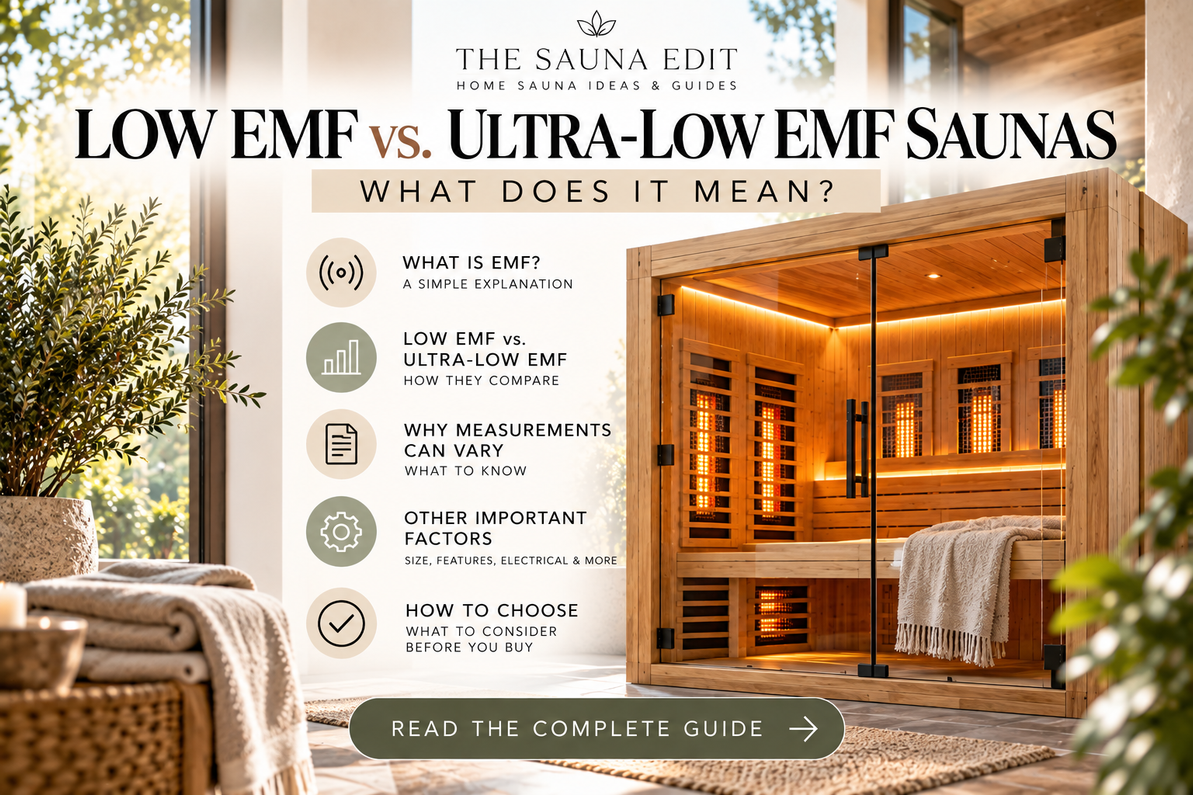
Low EMF vs. Ultra-Low EMF Saunas: What Does It Mean?
Low EMF vs. Ultra-Low EMF Saunas: What Does It Mean?
If you've been researching infrared saunas, you've probably seen descriptions such as low EMF, ultra-low EMF and near-zero EMF.
These terms appear frequently in sauna product descriptions, but they can be confusing—especially when you're trying to compare models from different manufacturers.
What exactly is EMF? What's the difference between low and ultra-low EMF? And what should you actually look at when comparing infrared saunas?
Here's what to know before you buy.
What Does EMF Mean?
EMF stands for electromagnetic field.
Electromagnetic fields are produced by many electrical devices and systems. In an infrared sauna, electrical components such as heaters, wiring and controls can contribute to measured electromagnetic fields.
When sauna manufacturers discuss EMF, they're generally referring to measurements taken around components of the sauna while it is operating.
What Is a Low EMF Sauna?
A low EMF sauna is an infrared sauna designed or configured to produce relatively low measured electromagnetic fields compared with other designs.
However, there's an important detail shoppers should understand:
“Low EMF” isn't necessarily a standardized specification across every sauna manufacturer.
Different companies may use different thresholds, testing procedures and measurement locations when describing their products.
That's why it's helpful to look at the manufacturer's actual published specifications rather than relying only on the words “low EMF.”
What Is an Ultra-Low EMF Sauna?
Some manufacturers also offer ultra-low EMF saunas.
Generally, the term is used to distinguish certain models as having lower measured EMF levels than the manufacturer's standard low-EMF models.
Again, terminology can vary by manufacturer.
When comparing saunas, look for specific information about how measurements were taken and what measurements the manufacturer reports.
What Does Near-Zero EMF Mean?
You may also encounter infrared saunas advertised as near-zero EMF.
This is another manufacturer or marketing designation intended to describe very low measured EMF levels.
It shouldn't automatically be interpreted as literally zero electromagnetic field in every location or under every operating condition.
If this specification matters to you, review the manufacturer's published testing information for the exact sauna model you're considering.
Why Can EMF Measurements Vary?
Two EMF measurements for the same sauna may not necessarily be identical.
Measurements can potentially vary depending on factors such as:
- Where the measurement is taken
- Distance from the heater or electrical component
- Which component is being measured
- How the sauna is operating
- Measurement equipment and methodology
This is one reason comparing a single number without understanding the testing conditions may not tell the whole story.
Is EMF the Only Thing to Consider?
No.
EMF specifications may be one factor you want to consider, but they shouldn't cause you to overlook the other characteristics of the sauna.
When comparing infrared saunas, also look at:
- Sauna dimensions
- Interior space
- Heater type and placement
- Infrared technology
- Electrical requirements
- Construction
- Included features
- Warranty
- Installation requirements
The right sauna for your home should fit your space, electrical setup, preferred features and budget, in addition to any EMF preferences you may have.
Does Full Spectrum Mean Low EMF?
Not necessarily.
Full spectrum and EMF describe different characteristics of a sauna.
Full spectrum refers to the infrared wavelength ranges the sauna is designed to provide, generally incorporating near, mid and far infrared.
EMF terminology refers to measured electromagnetic fields associated with electrical components.
A full-spectrum sauna may have a particular EMF classification, but you shouldn't assume its EMF level based solely on the fact that it's full spectrum.
Always check the specifications for the individual model.
What Else Should You Compare?
Once you've narrowed your search based on EMF preferences, compare the rest of the sauna carefully.
For example, consider how many people will normally use it.
A compact one-person sauna can be a great option when space is limited, while larger two-, three- or multi-person models provide additional interior room.
Also check the actual exterior dimensions rather than relying only on the advertised person capacity.
Check the Electrical Requirements
Electrical requirements vary among infrared sauna models.
Depending on the sauna's size and heater configuration, electrical requirements may differ significantly.
Before purchasing, review the manufacturer's specifications for the exact model.
If you're unsure whether your home's electrical setup meets those requirements, consult a qualified electrician.
How Should You Compare Low EMF Saunas?
Instead of shopping based solely on a label, take a broader approach.
First, determine what size sauna fits your space and how many people you expect to use it.
Then compare:
EMF specifications → infrared technology → heater configuration → dimensions → electrical requirements → features → warranty
This makes it much easier to compare saunas based on the entire product rather than one specification.
Find the Right Infrared Sauna for Your Home
Terms such as low EMF, ultra-low EMF and near-zero EMF can be helpful when narrowing your search, but understanding the manufacturer's specifications is more useful than relying on the terminology alone.
Compare the measurements and testing information available for each model, then consider those specifications alongside the sauna's size, infrared technology, heater configuration, electrical requirements and features.
Ready to compare your options? Browse our infrared sauna collection to explore low-EMF, ultra-low-EMF and other home sauna options.
Recent Posts
-
Low EMF vs. Ultra-Low EMF Saunas: What Does It Mean?
Low EMF vs. Ultra-Low EMF Saunas: What Does It Mean? If you've been researching infrared saunas, you …Sep 30th 2026 -

Full Spectrum vs. Far Infrared Sauna: What’s the Difference?
Full Spectrum vs. Far Infrared Sauna: What’s the Difference? If you’ve started researching infrared …Sep 28th 2026 -

Infrared vs. Traditional Sauna: What’s the Difference?
Infrared vs. Traditional Sauna: What’s the Difference? If you're shopping for a home sauna, one of t …Sep 25th 2026